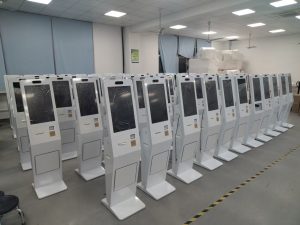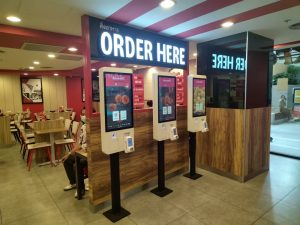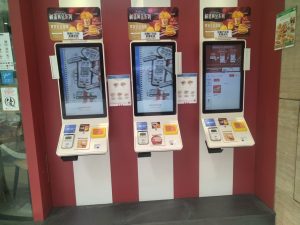
The efficiency gain comes from connecting the terminal to the POS and kitchen workflow rather than treating it as a standalone screen.
Competition in the restaurant and retail sectors is intensifying by the day. Rent and labor costs remain persistently high, while guests’ demands for efficiency and experience keep climbing. The traditional, extensive model of manual order-taking and cashering is becoming an invisible ceiling constraining store profit growth and brand upgrading.
Against this backdrop, self-ordering kiosks and smart checkout machines have emerged, using intuitive and convenient touch-interaction technology to reconstruct how “people, goods, and place” operate. They are not merely tools replacing labor – they are great marketing partners for raising average tickets, accumulating user data, and unlocking operational potential.
Pain Points of the Traditional Cashier Model
Long queues erode the guest experience
During dining peaks, snaking queues at the cashier have become the norm. Guests burn through their patience in anxious waiting, and the risks of abandoned purchases and negative reviews climb accordingly. Especially in shopping-center food courts, food preparation isn’t slow – but the “bottleneck effect” stuck at ordering and checkout directly drags down table turnover and guest satisfaction.
High labor costs squeeze operating profits
The “labor shortage” in the service industry keeps spreading, and the costs of recruiting, training, and retaining skilled cashiers rise year after year. A single store needs at least 2 – 3 dedicated cashier positions on rotating shifts; wages, social insurance, and room and board stack into heavy fixed overhead, continuously eroding already-thin profit margins. Adding temporary staff during holiday peaks is even harder.
Error-prone operations make financial reconciliation a headache
Cash received, change given, coupon redemption, member points… cashiers inevitably make mistakes – entering wrong dishes, missing orders, miscalculating discounts. This not only triggers guest disputes and ingredient waste but also causes end-of-day settlement data deviations, increases financial audit difficulty, and inflates management costs invisibly.
Advantages of Self-Ordering and Checkout
Fast ordering, reshaping the guest experience
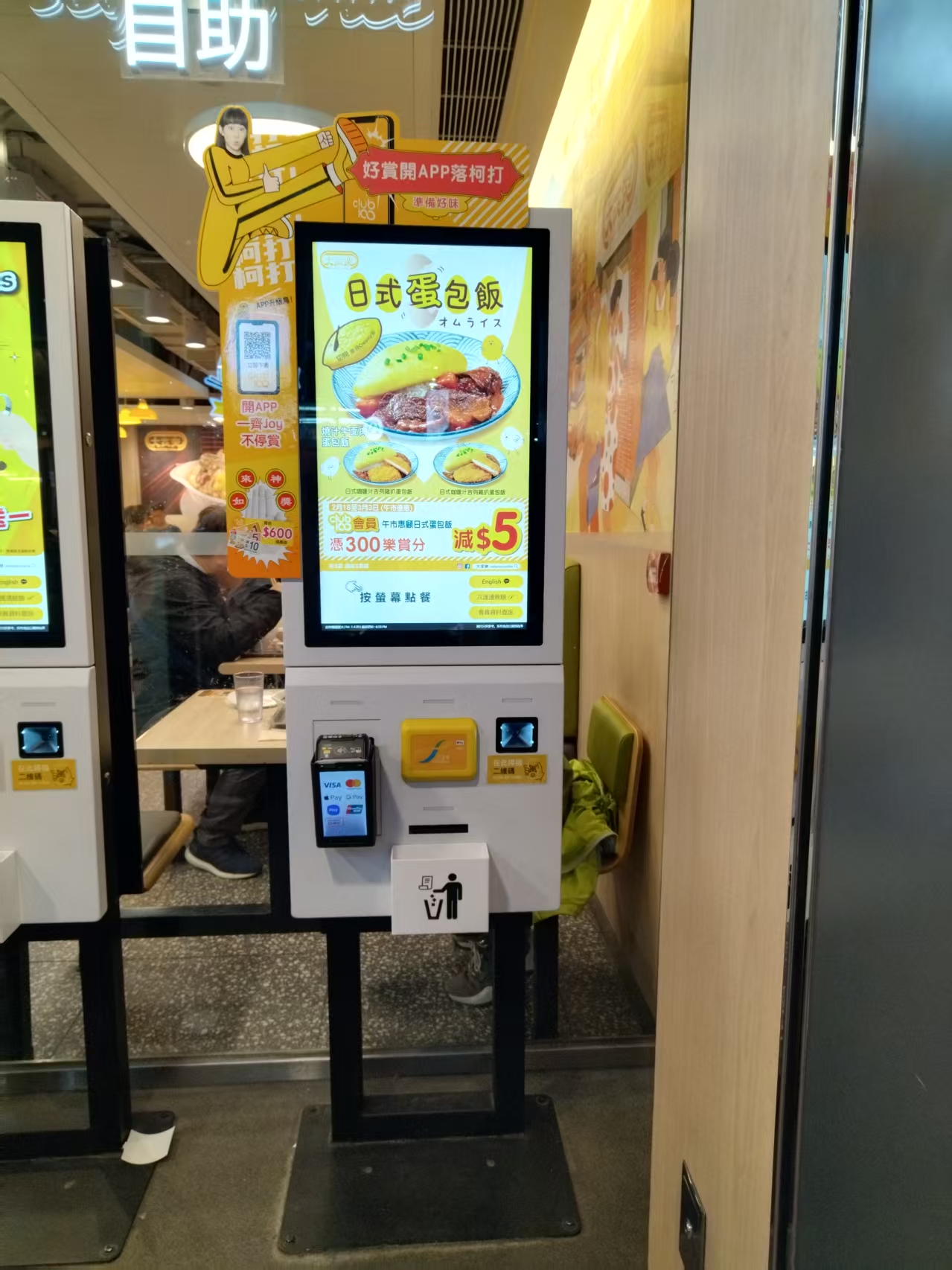
The large high-definition touch screen displays dishes in full – appearance, price, preparation method, and allergen notes – with rich text and imagery. Transparent information lets guests choose with confidence. Multi-language support easily serves foreign guests, eliminating communication barriers.
Guests browse and choose at their own pace, no longer constrained by the cashier’s speed. During peak-hour queues, guest flow is effectively diverted, and the ordering and dining experience improves markedly. The system also intelligently recommends “great-value add-ons,” “popular pairings,” and “limited-time specials,” quietly raising the average ticket.
Smart checkout, leaping settlement efficiency forward
Self-checkout machines support QR-code payment, facial payment, card payment, and more, compressing the checkout process from “staff operating one by one” to “guests paying themselves in seconds.” The system automatically calculates discounts, redeems coupon codes, and processes member points, reducing stubborn problems like wrongly calculated discounts, missed orders, and walkouts.
Billing data syncs to the back office in real time; daily and monthly reconciliation exports with one click. Financial efficiency multiplies, returning store operations from “chaos” to “order.”
Lower costs, higher efficiency, better store management
One self-service terminal can divert 30% – 50% of the order pressure from traditional cashiers, freeing employees once pinned to the register and redirecting them to higher-value tasks like guiding service, food recommendations, and guest-relationship maintenance – or simply cutting cashier headcount and converting the saved labor costs into profit gains.
The remote back office monitors device status in real time; menu prices and inventory listings update with one click – no need to visit each store to operate machines one by one. Multi-store chain management truly achieves “unified cloud control.”
Flexible configuration, multi-scenario coverage
Beyond restaurants, self-ordering and checkout machines also fit self-checkout zones in large supermarkets, ticket windows at cinemas and scenic areas, corporate smart cafeterias, convenience-store quick-payment points, and other diverse scenarios. Floor-standing, wall-mounted, and desktop form factors are supported, flexibly embedding into different spatial layouts.
Whether full-service dining, fast food, hot pot, or bakery and beverages, interface templates and functional modules can be configured on demand – truly achieving “a thousand stores, a thousand faces,” with seamless adaptation.
Practical Conclusion
A restaurant checkout kiosk can combine menu selection, order confirmation and payment to reduce repeated steps and support faster peak-period service. The final configuration should be verified against the real menu, transaction flow, installation space and support plan before deployment.
Deployment and Operating Checks
Planning for restaurant checkout kiosk should begin with the actual service flow rather than a generic demonstration setup. Before launch, test the workflow associated with restaurant checkout kiosk during realistic peak demand and confirm how staff will assist users. Documentation for restaurant checkout kiosk should cover cleaning, updates, network recovery and peripheral checks. A deployment involving restaurant checkout kiosk should pass consistent information to payment and back-office systems.
Explore related hardware configurations in the self-service kiosk product range.