

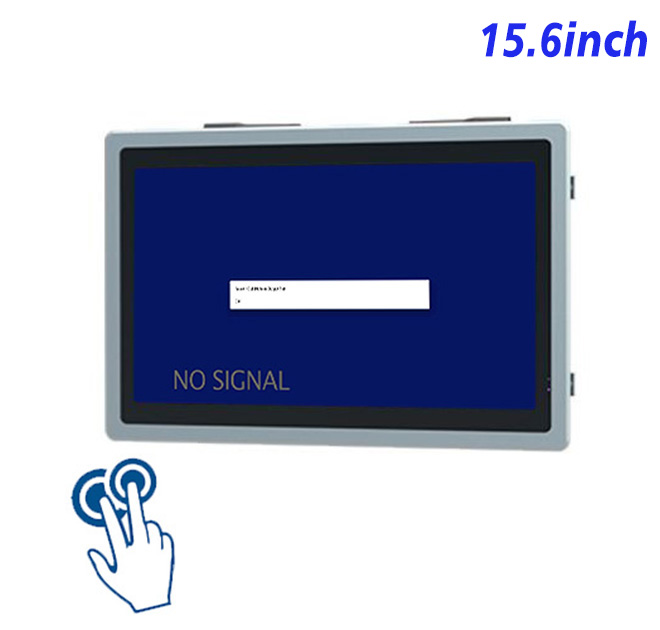
Give Setup Pages a Dedicated Full HD Surface
Operators rarely need another decorative display; they need a reliable point for a defined action. This industrial PCAP touchscreen display is suited to protected indoor robot setup and status stations, where it can present setup pages, status messages and maintenance references from a connected industrial computer. Planning around widescreen interaction while control remains in the robot system keeps the interface relevant to daily work.
The LCD, capacitive touch layer and input electronics form one display assembly, while computing remains in the external host. This distinction prevents buyers from expecting an operating system or application inside the monitor. The project still needs approved wiring, airflow, mounting clearances and peripheral ownership. Screen layout should be tested at the real viewing distance with the people who will use it.
Pair the Display with the Robot Host
| 15.6-Inch Embedded Capacitive Touchscreen Display Specification Document | ||||
| LCD Panel Parameters | Screen Size | 15.6 Inch | ||
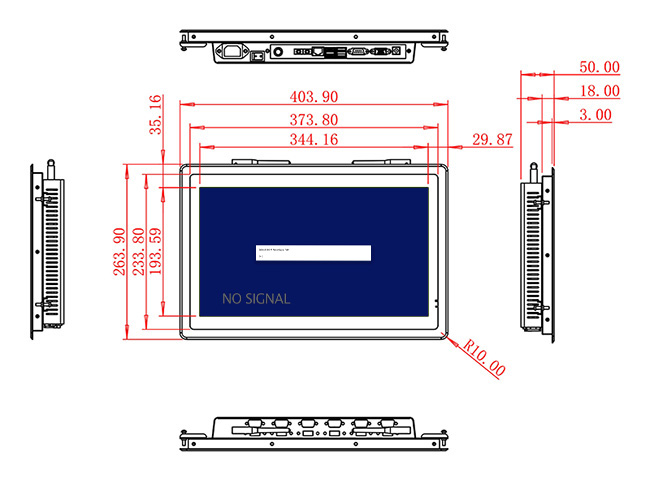
| Display Area | 344.16 mm.(Height) X 193.59(Width)mm. | |||
| Aspect Ratio | 16 : 9 | |||
| LCD Type | a-Si TFT-LCD Monitor | |||
| Maximum Resolution | 1920 X 1080 | |||
| Display Color | 16.7M , 72% NTSC | |||
| Brightness | 250cd/m² | |||
| Contrast Ratio | 700 : 1 | |||
| Viewing Angle (Up/Down/Left/Right) | 89°/89°/89°/89° (Type)(CR≥10) | |||
| Response Time | 30ms | |||
| LCD Panel Lifespan (Hours) | 60,000(Hour.) | |||
| Field Frequency | 60Hertz | |||
| PCAP Touchscreen Panel Parameters | Touch Pattern | Projected Capacitive Touchscreen Monitor | ||
| Touch Points | 10 Points | |||
| Cover Glass | Morse Glass Size 7 Physically reinforced to prevent explosion | |||
| Glass 3 mm. Optical mount to reduce parallax | ||||
| Glass Transmission | >85% (Higher light transmission depends on glass coating technology For example AR/AG) >85% | |||
| Response Speed | < 6ms | |||
| Touch Accuracy | More than 90% of the touch area ±2 mm | |||
| Touch Method | Inch Stylus | |||
| Output Format | Coordinate Output | |||
| Click Time | Unlimited | |||
| Smallest Touch Size | 5 mm | |||
| Long-lasting Durability | Yes, Available | |||
| Touch Interface | USB | |||
| Operating Temperature and Humidity | Below 10℃ ~ +50℃, ≤ 85%RH | |||
| Storage Temperature and Humidity | Less than 20℃ ~ +60℃, ≤ 90%RH | |||
| Audio Parameters (External Speaker Option) |
Audio system | Stereo | ||
| Speaker size | ≈ 99 x 45 x 20 mm | |||
| Impedance | 8 Ω | |||
| Power | 2 x 5 Watt | |||
| Loudness | > 80 Decibel | |||
| Interface | 4-pin connector | |||
| Onboard Interface | HDMI Input | 1 | ||
| VGA Input | 1 | |||
| DVI Input | 1 | |||
| USB Type B or any desired USB Type | 1 | |||
| Power | Power Supply | Alternating Current 100V~240V, 50/60Hz | ||
| Maximum Power Loss | ≤ 30 Watt | |||
| Standby Mode Power Loss | < 1 Watt | |||
| Features | Operating Temperature | 0℃ ~ 50℃ | ||
| Storage Temperature | Below 10℃ ~ +60℃ | |||
| Accessories | Power Cord Length | 1.5m | ||
| HDMI Cable Length | 2m | |||
| USB-A to USB-B Cable Length | 1.5m | |||
| Stereo Speaker Size with Connector | 99*45*20mm | |||
| Stereo Speaker Length | 1.5m | |||
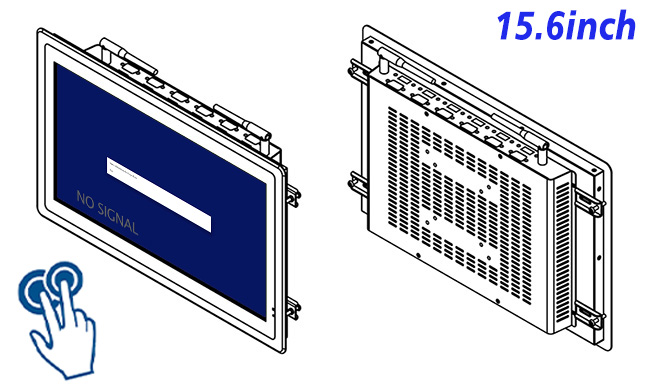
| Package Size | Device Dimensions | 403.9 X 263.9X 50mm. | ||
| Net Weight | 5 Kilogram | |||
| Package Size | 47 X 33 X 15Centimeter | |||
| Gross Package Weight per Unit | 5.5 Kilogram | |||
Robot host
The documented 15.6-inch LCD provides 1920 × 1080 resolution, 250 cd/m² brightness and 700:1 contrast. It uses a 10-point projected-capacitive touch layer with USB interface, 3 mm strengthened cover glass, more than 85% transmission, less than 6 ms response and stated touch accuracy. The display requires an external industrial computer supplied and validated separately. Available connections include HDMI, VGA and DVI video inputs plus USB touch connection. Maximum power consumption is 30 W, while the listed device dimensions are 403.9 × 263.9 × 50 mm. These values must remain tied to the approved configuration because options shown in the same table are not automatically combined.
The numbers describe the base hardware rather than a finished business system. Application performance depends on the external computer, graphics output, USB touch mapping, software and connected equipment. Video input and USB touch should be documented as separate paths. Procurement documents should repeat the approved option set instead of copying every alternative from the specification table.
Keep USB Touch separate from Motion Control
Safety boundary
A stable installation begins by matching the host resolution and video output to the display, then connecting USB for touch coordinates. The team should test startup order, signal loss, sleep and wake behavior, touch alignment and recovery after the host restarts. Open administrator access and undocumented changes create avoidable support work.
Panel integration
Robot motion, interlocks, emergency functions and operating permissions must remain in the approved robot controller. Product title, sales copy, drawings, software scope and bill of materials should describe the same finished capability. This protects both the buyer and integrator from assuming that an application, certification or peripheral is included when it is not.
Plan the Panel Opening for Service Access
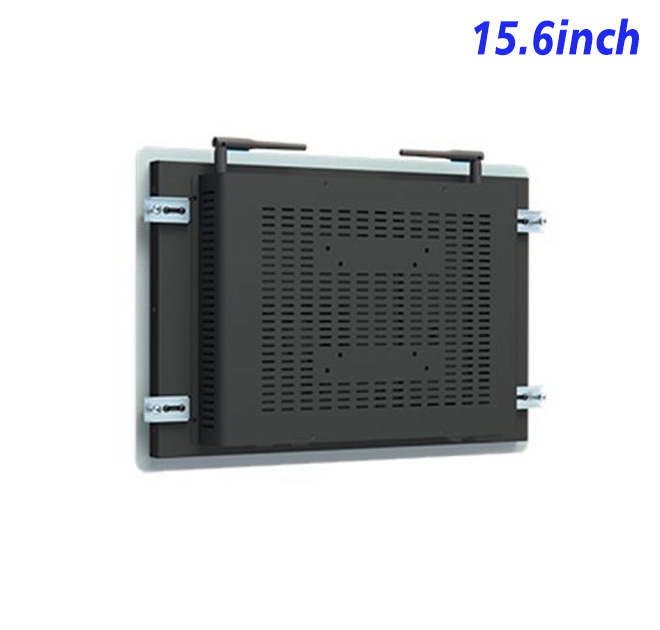
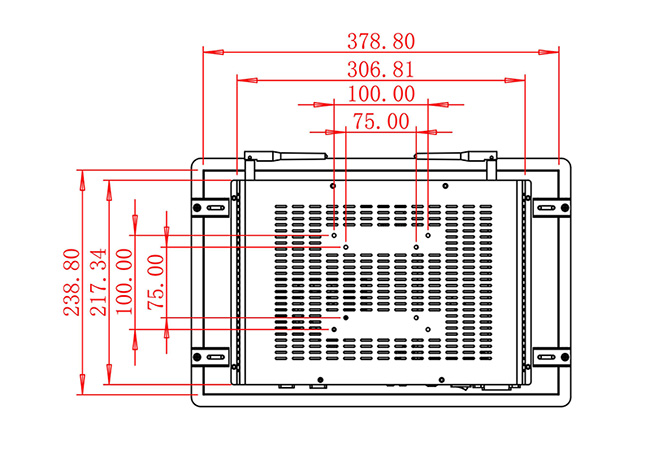
Mechanical integration drawings should identify the front opening, fixing points, rear depth, ventilation path, power route, video and USB routes, connector access and removal clearance. A scanner, printer, reader, camera or payment module should be documented and serviced independently instead of becoming inaccessible behind the panel.
Touch interaction also needs realistic testing. Long labels, multilingual content, invalid entries, unavailable records and interrupted connections reveal more than a perfect demonstration. Buttons, warning states and confirmation steps should remain readable without requiring users to understand the internal system.
Validate Alarms and Restart Behaviour
Touch calibration
The first industrial PCAP touchscreen display should be treated as an engineering sample. Acceptance can record signal acquisition, native resolution, USB touch alignment, sleep recovery and cable retention. The team should also confirm that no product model appears in customer-facing marketing text.
A representative workflow should run from the opening screen to the final confirmation or exception. Measure task time, repeated touches, staff assistance and recovery steps. Findings can be corrected in the host software, cable plan or fixture before volume production, when changes remain inexpensive.
ZXTLCD can review the screen option, host output and touch connection, touch workflow, mounting drawing, peripherals, quantity and operating conditions before production. For repeat industrial PCAP touchscreen display projects, the approved sample record helps purchasing, engineering and after-sales teams keep the panel, touch layer, input board and cables, connectors and mechanics consistent.
Handover records should include the host resolution, video input, USB touch mapping, connector map, drawing revision and replacement procedure. This gives future batches and spare units a practical reference without turning the product page into a promise of unsupported functions.
Request Product Information
If you would like to get the specification about above product, or you hope to discuss your requirements or need any additional information on our this product , then please do not hesitate to send us a inquiry and contact our sales team now.